The Caspian Sea has become the latest region to be sucked into the growing conflict between Iran and its adversaries – not least because it’s a vital artery in the growing relationship between Iran and Russia.
Ukraine at the weekend said its drones had struck two Russian vessels carrying military cargoes in the Caspian, the world’s largest inland body of water. It asserted that both had left Iran for a Russian port.
In a post on X Saturday, Ukrainian President Volodymyr Zelensky said the targets included “ships that were involved in transporting military cargo from Iran, as well as a warship,” subsequently identified by Ukraine’s security service as a Russian missile boat.
Iran countered that one of its commercial vessels carrying a cargo of iron had been struck, killing one seafarer and injuring three others.
The ship, which it did not name, was sailing from the Russian port of Astrakhan to Anzali in Iran, which Iranian regional governor Hadi Hagh-Shenas described as “a safe and reliable corridor for commercial exchanges between the two ports.”
Tensions escalated further Monday when Iranian foreign ministry spokesman Esmail Baghaei said, “Ukraine’s dangerous adventurism will certainly not go unanswered by us.” Meanwhile, Ukraine’s Chargé d’Affaires in Tehran was summoned to the foreign ministry over the incident.
Iranian Foreign Ministry spokesman Esmail Baghaei speaks at a weekly press conference in Tehran, Iran, on June 23.
Xinhua/Shutterstock
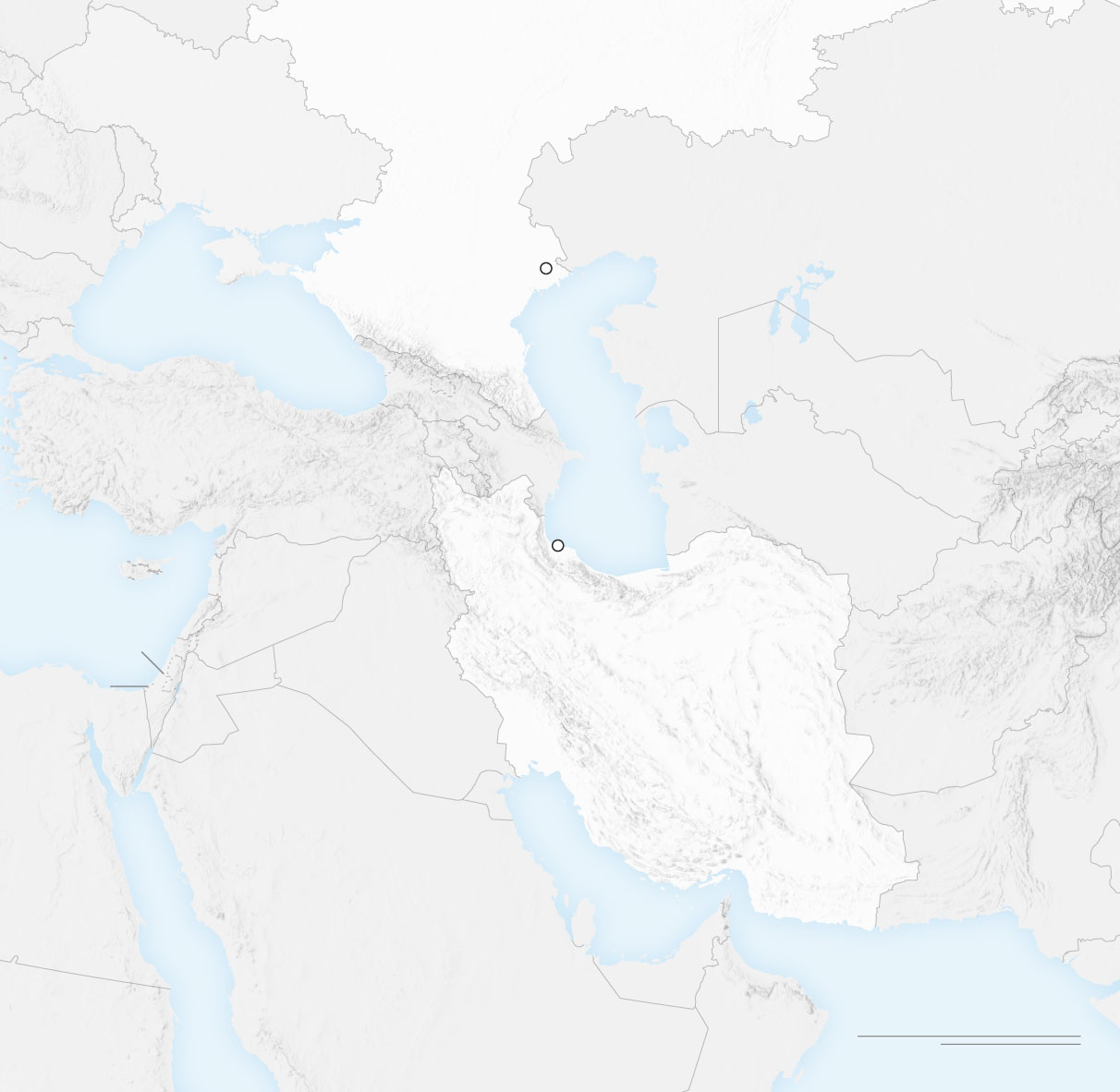
Where is the Caspian Sea?
The recriminations reflect the growing importance of the Caspian, which is bordered by five countries, including Iran and Russia. With the blockade of Iranian ports in the Persian Gulf and the Gulf of Oman, the Caspian has taken on new significance as a trade route.
The Caspian can help Iran towards “a diversified trade strategy, especially if Iran promotes trade with Russia, the Caucasus, Central Asia, China via rail, and, indirectly, Eastern Europe,” according to Bijan Khajehpour, managing partner of Vienna-based Eurasian Nexus Partners, a consulting firm.
It is “a strategic complement rather than a substitute for Iran’s existing maritime access through the southern waters,” Khajehpour told CNN.
RUSSIA
UKRAINE
KAZAKHSTAN
Astrakhan
Black Sea
Caspian
Sea
GEO.
Uzb.
ARM.
AZER.
TURKEY
TURKMENISTAN
Med.
Sea
Anzali
SYRIA
Leb.
Israel
AFGHANISTAN
IRAQ
IRAN
Gaza
JOR.
KUWAIT
EGYPT
PAKISTAN
Persian
Gulf
QATAR
Red
Sea
Saudi
Arabia
UAE
OMAN
500 miles
SUDAN
500 km
Russian grain and steel are among the cargoes that cross the Caspian. Iran has developed several significant ports on the sea, among them Anzali. Oil and gas from Kazakhstan are transported from the Caspian to a hub on the Black Sea.
For Russia, the Caspian is an important conduit to central Asia and Iran – and a critical route in its expanding strategic partnership with Tehran, one that has a military component as well as Russia’s role in Iran’s civilian nuclear program and oil exploration in Iran.
“The recent blockade by the US (of Iranian ports) has underlined the strategic value of the Caspian Sea route” says Khajehpour. It is also less vulnerable to international sanctions because it is landlocked and largely controlled by Iran, Russia and neighboring states beyond Western naval reach
Why is the sea so valuable to both Iran and Russia?
Russian Foreign Minister SergeI Lavrov, right, and Iranian Foreign Minister Abbas Araghchi, pose for a photo in Cholpon-Ata, Kyrgyzstan, on Friday.
Russian Foreign Ministry Press Service
The Caspian has become a passageway for the growing military links between Moscow and Tehran. Iran and Russia have a broad strategic agreement covering economic and military collaboration, although it is not a mutual defense pact.
Russia received its first batches of Iranian Shahed attack drones via the Caspian early in its war with Ukraine and has since produced new versions of the drones in plants on Russian soil.
The Caspian route linking Iran’s northern ports to the Russian port of Astrakhan has been targeted by Ukraine before. Last August a cargo ship – the Port Olya 4 – was destroyed while reportedly loaded with Shahed-136 drone components and Iranian munitions.
In 2024, CNN reported that a Russian cargo ship suspected of carrying Iranian ballistic missiles for Moscow’s war against Ukraine was seen at a Russian port on the Caspian Sea. The US Treasury department assessed that the Russian Ministry of Defense had “used the vessel Port Olya-3 to transport CRBMs (close-range ballistic missiles) from Iran to Russia.”
Then-US Secretary of State Antony Blinken said Washington believed the Russian military had received shipments of Iranian Fatah-360 ballistic missiles and would “likely use them within weeks in Ukraine against Ukrainians.”
At the same time, the US National Security Council warned of the deepening military cooperation between Iran and Russia. Spokesperson Sean Savett told CNN back then that “any transfer of Iranian ballistic missiles to Russia would represent a dramatic escalation in Iran’s support” for the Kremlin in its invasion of Ukraine.
Iran denied it was providing military assistance to Russia at that time.
A woman with her cat stands near an apartment building hit by a Russian air strike in the town of Pavlohrad, Dnipropetrovsk region, Ukraine July 20.
2026 Stringer/Reuters
What is Ukraine hoping to achieve from its strikes?
Ukraine’s drone attacks on vessels and energy infrastructure in the Caspian at the weekend are a demonstration of its growing long-range capabilities and its goal of damaging the industries that support Russia’s war effort.
It’s also a recognition that Iran – like North Korea – plays a significant role in supplying Russia with weapons.
And above all, it’s astute timing from the Ukrainians, with Zelensky traveling to Washington this week to meet with President Donald Trump. Besides the Caspian strikes, Zelensky has said that according to Ukrainian intelligence Russia has provided satellite data to Iran to carry out attacks on US facilities in the Middle East.
Ukrainian and European officials say President Vladimir V. Putin has become emboldened by a lack of Western pushback. The police inspected the damage to a house caused by debris from a shot-down Russian drone in the village of Wyryki-Wola, eastern Poland on Wednesday. Credit... Wojtek Radwanski/Agence France-Presse — Getty Images By Andrew E. Kramer Reporting from Kyiv, Ukraine The New York Times , Sept. 11, 2025 Updated 8:49 a.m. ET An American factory in western Ukraine. Two European diplomatic compounds and a key Ukrainian government building in Kyiv. And now Poland. Over a roughly three-week period, Russian drones and missiles have struck sites of increasing sensitivity for Ukraine and its Western allies, culminating in the volley of Russian drones that buzzed early Wednesday over Poland, a NATO country. For decades, American and European military planners feared something else: a bolt-from-the-blue assault, like an all-out nuclear strike, from the Soviet Union or ...
A bold Ukrainian operation in Kursk has humiliated Russian President Vladimir Putin and upended some of the logic of the ongoing war between Russia and Ukraine. Column by Ishaan Tharoor The Washington Post , August 14, 2024 at 12:00 a.m. EDT; see also Ukrainian soldiers pose for a picture as they repair a military vehicle near the Russian border on Sunday. (Viacheslav Ratynskyi/Reuters) Russia’s Kursk oblast is no stranger to war. In medieval times, the district was overrun by the Mongol horde, and was claimed and ceded down the centuries by Eurasian empires. During World War II, the environs of the city of Kursk became the site of the greatest tank battle in history, as Nazi Germany suffered a grievous strategic defeat at the hands of the bloodied yet unbowed Soviet Union . This past week, Kursk has been the site of the first major invasion of Russian territory since then. This time, it’s not the Nazi war machine rolling in — no matter what Kremlin propagandists insi...




Comments
Post a Comment