Trump admin bars 5 Europeans it says led drive to "censor" U.S. views online
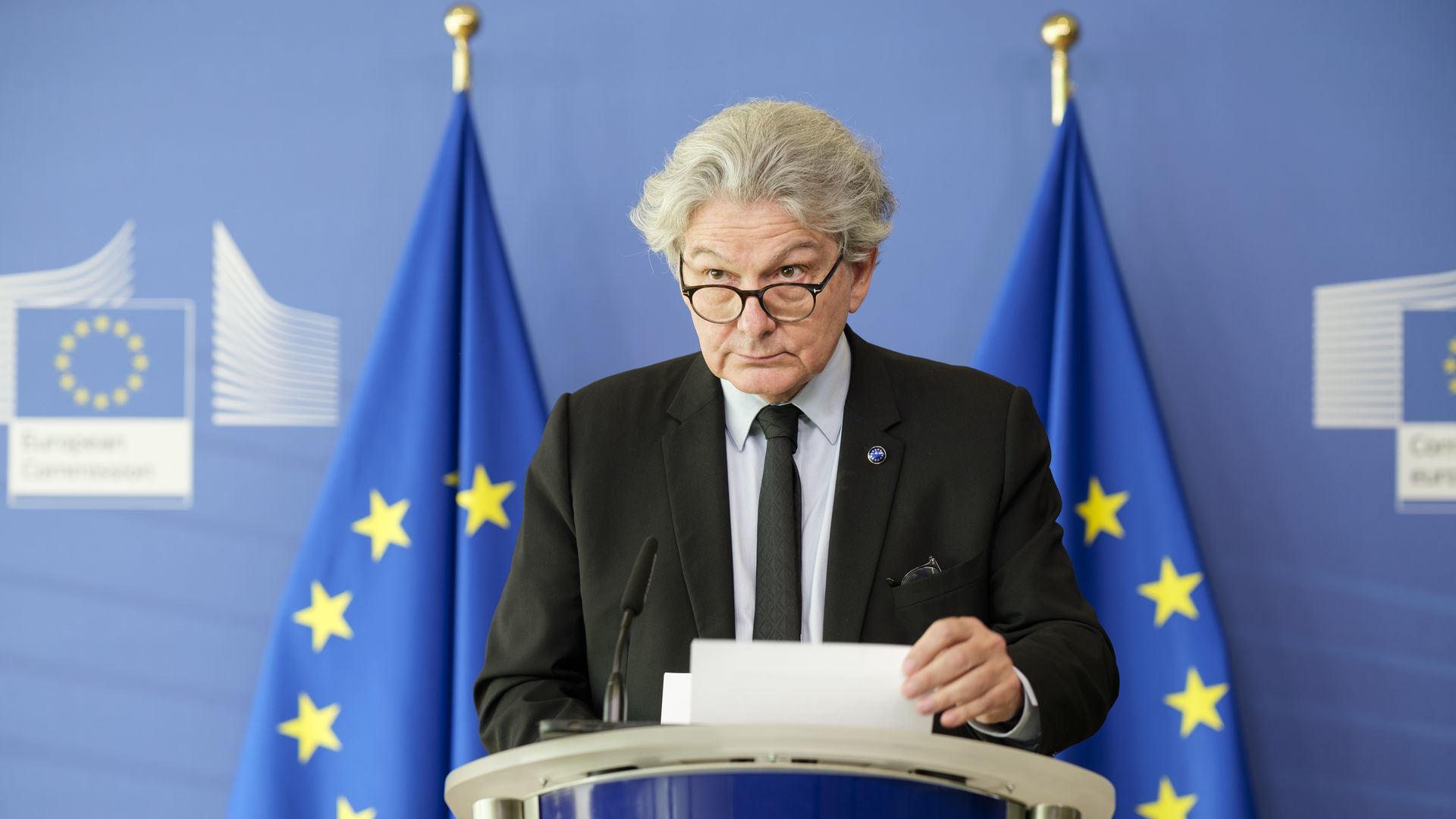
Then-European Commissioner for Internal Market Thierry Breton at the EU Commission headquarter in Brussels, Belgium, in 2023. Photo: Thierry Monasse/Getty Images
The Trump administration imposed visa restrictions Tuesday on five Europeans the State Department accused of leading "efforts to coerce American platforms to censor" or "suppress" U.S. viewpoints they oppose.
The big picture: Among those now barred from entering the U.S. is former EU Commissioner Thierry Breton, whom under secretary of state for public diplomacy Sarah Rogers on X called "a mastermind of the Digital Services Act," which imposes requirements on social media platforms, including content moderation.
The former top EC tech regulator, who served as commissioner for the internal market from 2019-2024, clashed with Trump ally Elon Musk over complying with European Union rules.
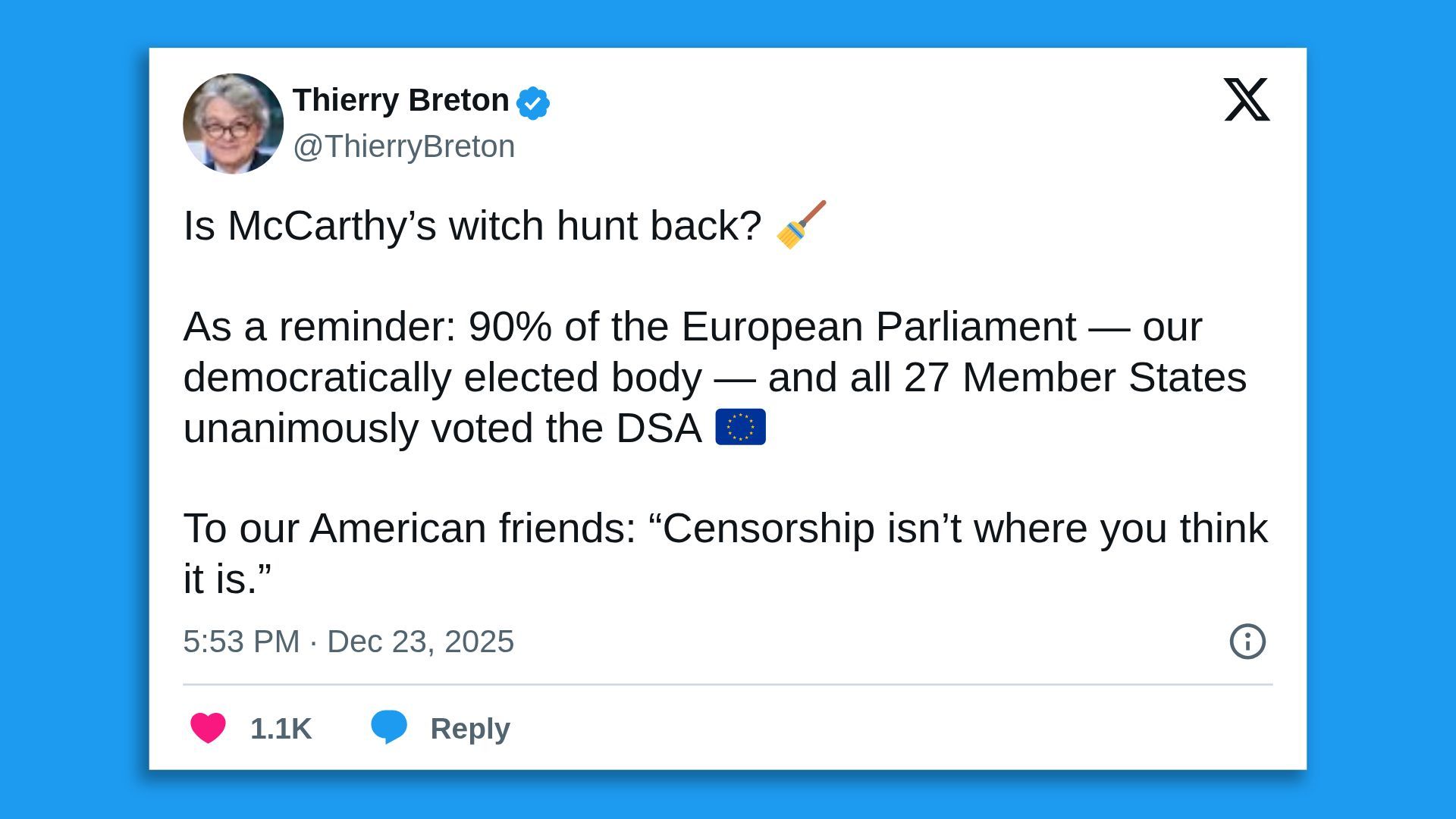
Breton, who served in the late conservative French President Jacques Chirac's government, suggested on Musk's X platform that the Trump administration's action was a "witch hunt."
State of play: The European Commission announced earlier this month it had issued X with a fine of €120 million ($141 million), its first penalty under the DSA.
The fine was issued on the same day as the Trump administration released its National Security Strategy, which accused the EU of censoring free speech.
X responded by shutting down the EC's ad account and Secretary of State Marco Rubio called the fine "an attack on all American tech platforms and the American people."
Rubio said in a statement Tuesday the five Europeans were "radical activists" who had "weaponized NGOs [that] have advanced censorship crackdowns by foreign states."
He said in each case they had targeted American speakers and U.S. companies.
Of note: Rubio didn't name the individuals affected by the ban, but Rogers did in a series of X posts.
The others Rogers named were: Imran Ahmed, chief executive of the Center for Countering Digital Hate, whom Musk sued in 2023 after it documented hate speech on X; Clare Melford, who leads the U.K.-based Global Disinformation Index; and Josephine Ballon and Anna-Lena von Hodenberg, leaders of German nonprofit HateAid.
Zoom in: Rubio said in his statement, "President Trump has been clear that his America First foreign policy rejects violations of American sovereignty. Extraterritorial overreach by foreign censors targeting American speech is no exception."
He wrote on X that for "far too long, ideologues in Europe have led organized efforts to coerce American platforms to punish American viewpoints they oppose."
The Trump administration "will no longer tolerate these egregious acts of extraterritorial censorship," Rubio added.
What they're saying: French Minister for Europe and Foreign Affairs Jean-Noël Barrot said on X Tuesday France "strongly" condemns the visa restrictions.
"The Digital Services Act (DSA) was democratically adopted in Europe to ensure that what is illegal offline is also illegal online," he said.
"It has absolutely no extraterritorial reach and in no way concerns the United States."
Hodenberg and Ballon said in a media statement the action marked an "act of repression by a government that is increasingly disregarding the rule of law and trying to silence its critics by any means necessary."
They added: "We will not be intimidated by a government that uses accusations of censorship to silence those who stand up for human rights and freedom of expression."
French President Emmanuel Macron similarly condemned the U.S. move, writing on X Wednesday that the "measures amount to intimidation and coercion aimed at undermining European digital sovereignty."
He added, that the "rules governing the European Union's digital space are not meant to be determined outside Europe."
What we're watching: Rubio said in his statements the State Department "stands ready and willing to expand" its visa restrictions list if others did not reverse course.
Go deeper: Big Tech hopes for Trump defense against EU fines


Comments
Post a Comment